
“The future is already here—it’s just not very evenly distributed.”
— William Gibson

Shuyuan Hu

胡书源

I am a Research Assistant at MINT Lab, Shanghai Jiao Tong University, where I’m very fortunate to be advised by Prof. Bo Zhao. My research tries to answer the following two questions:

  1. The last mile of real-world deployment: How can reinforcement learning raise a policy’s success rate in a new environment to 99% with as little post-training as possible?

  2. Structure and bias in human demonstrations: Human demonstration trajectories are suboptimal and biased. How can we extract useful structure from them while removing those biases?

I received my Master of Science in Computer Science from the University of Southern California and my Bachelor of Science in Computer Science from the University of Leeds (rank: 1/50).

Shuyuan Hu beside a river, with mountains and a blue sky in the background. Shuyuan Hu carrying a snowboard in snowy mountains.
Beyond the labBack to lab

In my spare time, I like Sci-Fi, Anime, and Skiing.

Research

Selected research.

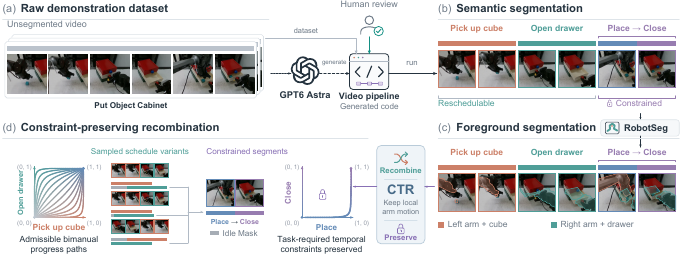
Constraint-preserving Temporal Recombination preserves task coordination while varying the schedules of bimanual demonstrations.

01Submitted to ICLR 2027

Learn the Task, Not the Schedule: Reducing Spurious Cross-Arm Coupling in Bimanual Imitation Learning

Shuyuan Hu, Deng-Ke Wu, Yifan Jin, Qianhang Luo, Mingchen Ju, Kai Ye, Bo Zhao

Abstract

A bimanual demonstration specifies both what the robot should do and one particular schedule for when each arm should act. Standard imitation learning does not distinguish task-required cross-arm constraints from incidental scheduling choices, and may therefore exploit opposite-arm progress as a shortcut cue, creating spurious cross-arm coupling even where relative timing is irrelevant for the current task phase. We introduce Constraint-preserving Temporal Recombination (CTR), a training-time data intervention that preserves recorded arm-local sensorimotor content while retiming the corresponding segments to realize admissible schedules that preserve task-required cross-arm constraints. We use CTR to train Diffusion Policy, Action Chunking with Transformers, and π0.5, and evaluate them on four simulated and four real-robot tasks. Across six real-robot bimanual progress-state initializations, CTR raises worst-state success from 56% for the strongest non-CTR schedule mixture to 76%. With π0.5 on an Independent task, a 4 s pause transfers 2.56 s of delay to the opposite arm under the Concurrent schedule distribution, but only 0.25 s with CTR. On real robots, CTR violates task constraints in only 0–4% of trials, versus 36–98% for narrow-schedule baselines.
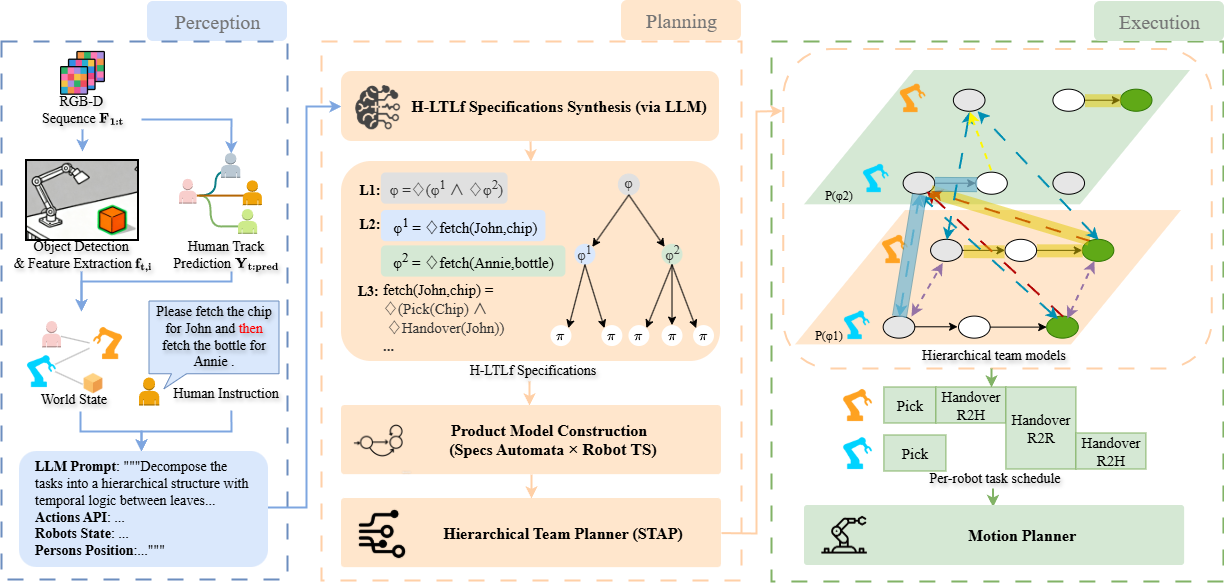
A multi-robot handover demonstration and overview of the dynamic planning framework.

02IROS 2026 · Accepted

LLM-Grounded Dynamic Task Planning with Hierarchical Temporal Logic for Human-Aware Multi-Robot Handover

Shuyuan Hu, Tao Lin, Kai Ye, Tianwei Zhang

Abstract

Large Language Models (LLMs) enable non-experts to specify open-world multi-robot tasks, but the generated plans are often kinematically infeasible and inefficient in long-horizon settings. Formal methods such as Linear Temporal Logic (LTL) offer correctness and optimality guarantees, yet they are typically offline and scale poorly. To bridge this gap, we propose a neuro-symbolic framework that grounds human instructions into hierarchical LTLf specifications (i.e., LTL on finite traces) and solves the resulting Simultaneous Task Allocation and Planning (STAP) problem. Unlike static approaches, our system handles stochastic environmental changes—such as user motion or updated instructions—through a receding-horizon planning (RHP) loop with real-time perception, dynamically refining plans over a hierarchical state space. Experiments in simulation and on real robots demonstrate that our approach significantly outperforms baseline methods in success rate and interaction fluency while reducing replanning overhead.

Open source

Built for real robots.

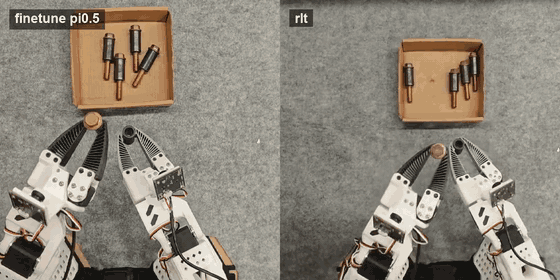
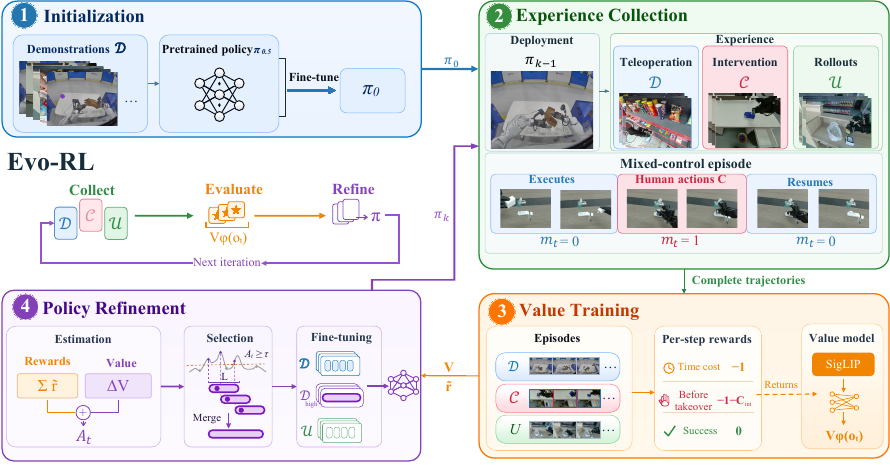
Evo-RL real-world reinforcement learning workflow.

Core Contributor

Evo-RL

Open real-world reinforcement learning pipelines for SO101 and AgileX PiPER/PiPER-X, with reproducible data collection, value learning, policy refinement, and robot deployment.

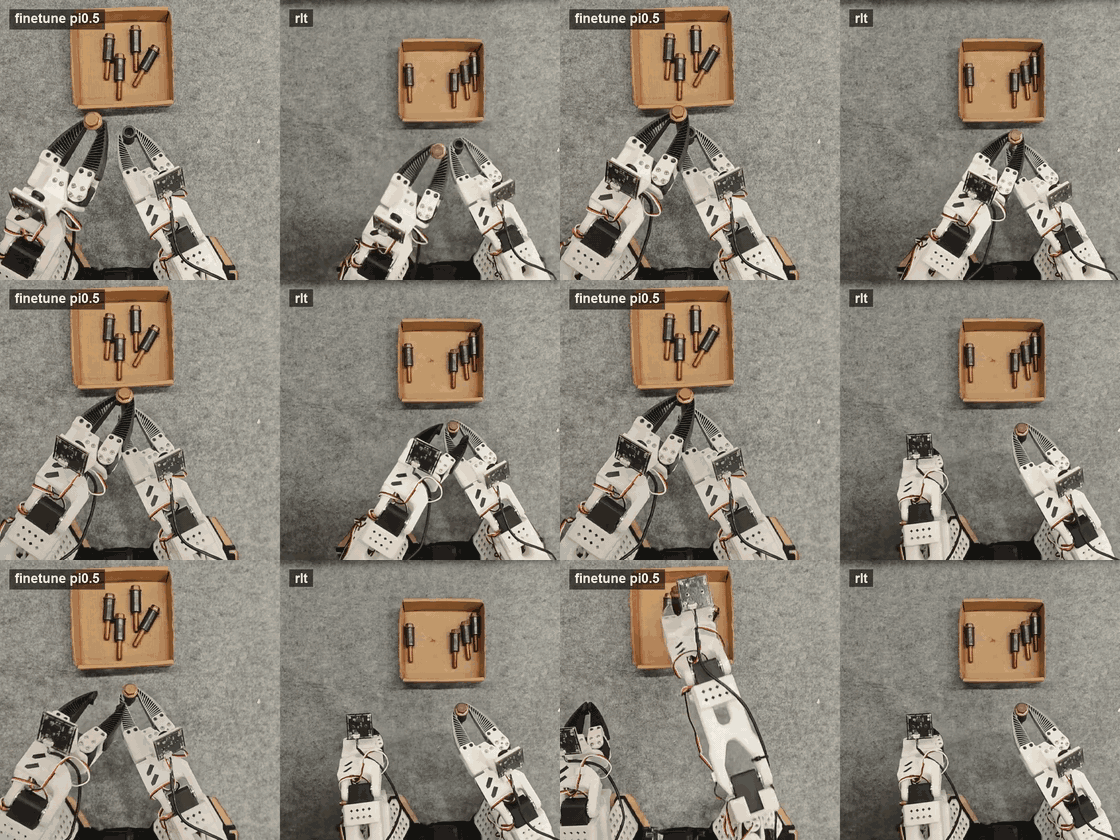
Evo-RLT real-robot rollout demonstration.

Project Lead

Evo-RLT

An independent LeRobot-based reproduction of RLT, covering VLA fine-tuning, RL-token learning, transition-cache generation, actor-critic training, and real-robot rollout.

Research

More research.

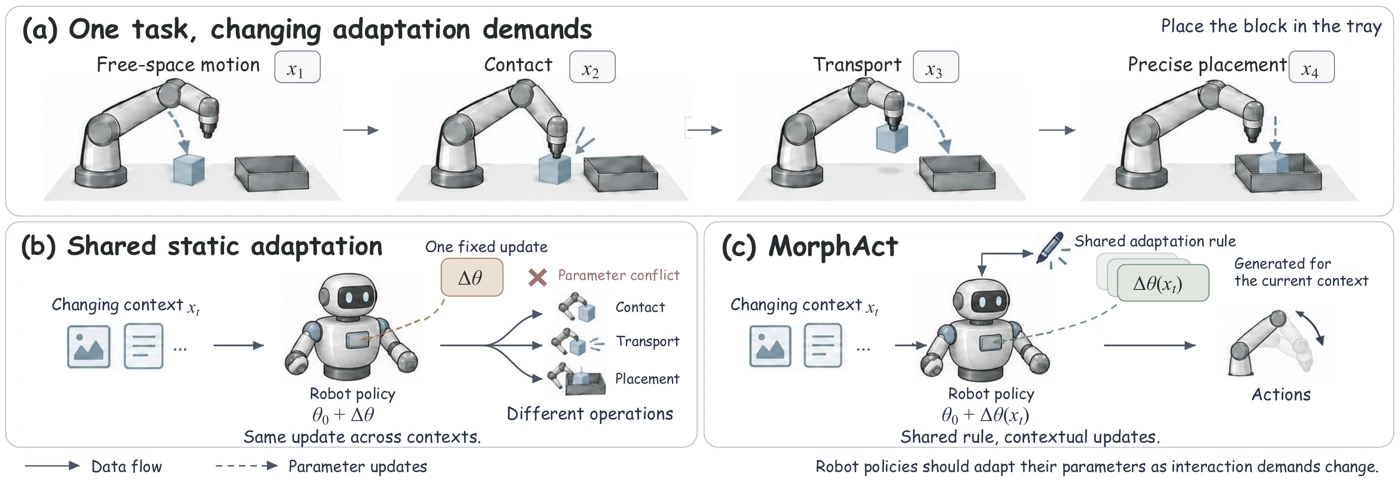
MorphAct reshapes a shared robot policy’s perception and action weights to meet changing interaction demands.

03Submitted to ICLR 2027

MorphAct: Robot Policies Morphing with the Worlds They Act In

Ziyan Liu*, Jiting Liu*, Weihong Zhong*, Wenda Yu, Yeqiu Chen, Jason Li, Xiaojiang Peng, Shuyuan Hu, Kai Wang, Bo Zhao

* Equal contribution.

The Evo-RL pipeline selects experience from demonstrations, human interventions, and autonomous robot rollouts.

04Submitted to ICRA 2027

Evo-RL: Iterative Robot Reinforcement Learning from Selective Experience

Kai Ye, Yifan Jin, Qianhang Luo, Hongru Zhang, Jiedong Zhang, Shuyuan Hu, Song-Yuan Wu, Jihai Xu, Jie Zhao, Bo Zhao

Abstract

Improving robot policies from execution feedback requires addressing two challenges: obtaining corrective behavior for difficulties encountered during deployment and identifying useful behavior within accumulated experience. To address these challenges, we propose Evo-RL, an iterative reinforcement learning method that combines human interventions with advantage-guided experience selection. Human interventions provide corrections for difficult states, while advantage estimates prioritize behavior in demonstrations and autonomous rollouts associated with lower execution-time and intervention costs. These complementary sources guide policy fine-tuning, followed by redeployment for further improvement. To support research on learning from these different experience sources, we introduce RW-RL, comprising over 1,000 hours of real-world interaction across four robot embodiments, with action-source metadata and semantic annotations. On real-world precision insertion, Evo-RL improves attempt success rate over RECAP by 30.46%. Our code, model checkpoints, and dataset are publicly available.

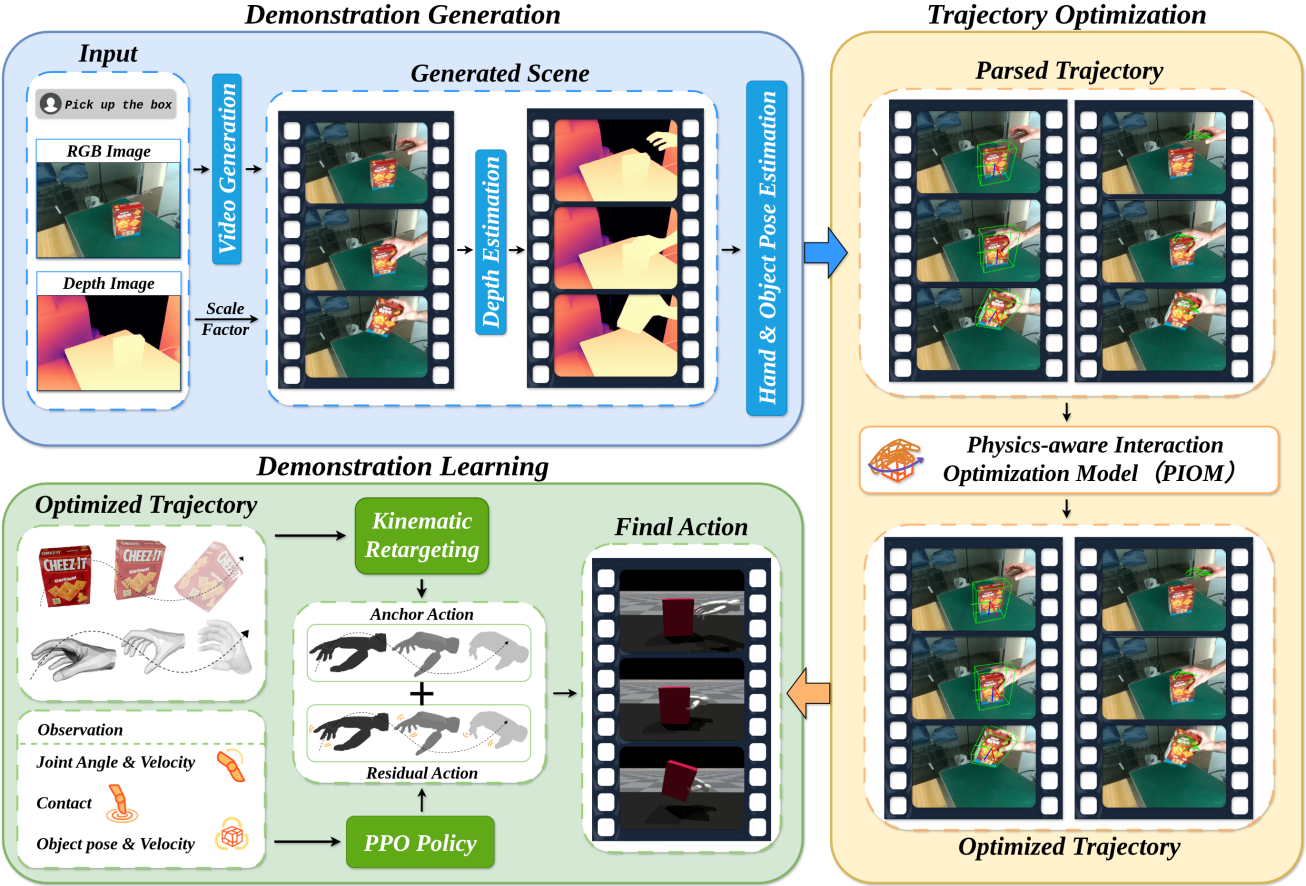
The Gen2Real pipeline connecting generated video to dexterous robot manipulation.

05arXiv · 2025

Gen2Real: Towards Demo-Free Dexterous Manipulation by Harnessing Generated Video

Kai Ye, Yuhang Wu, Shuyuan Hu, Junliang Li, Meng Liu, Yongquan Chen, Rui Huang

Submitted to RAL.

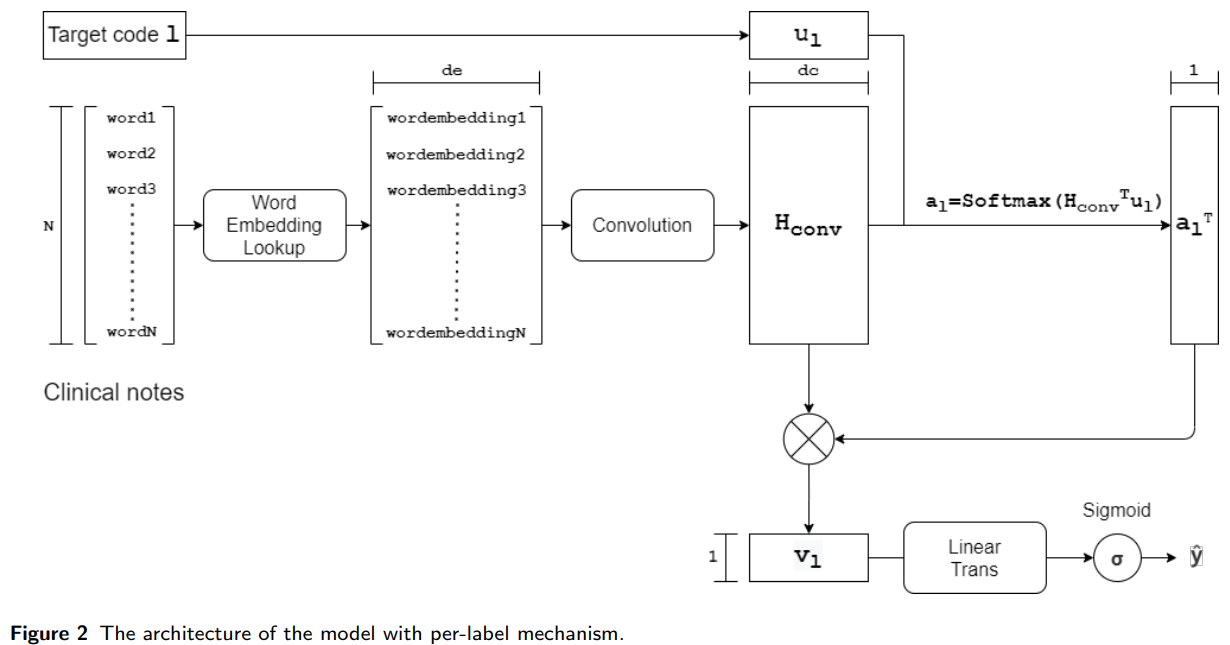
An overview of the explainable CNN architecture for medical code prediction from clinical text.

06BMC MIDM · 2021

An explainable CNN approach for medical codes prediction from clinical text

Shuyuan Hu, Fei Teng, Lufei Huang, Jun Yan, Haibo Zhang

BMC Medical Informatics and Decision Making, 21 (Suppl 9), 256, 2021.

Full citations, in one place.

Download bibliography

Updates

Along the way.

  1. My paper LLM-Grounded Dynamic Task Planning with Hierarchical Temporal Logic for Human-Aware Multi-Robot Handover was accepted to IROS 2026.

  2. I joined Prof. Bo Zhao’s group at Shanghai Jiao Tong University to work on real-robot reinforcement learning.

  3. I joined Shenzhen AIRS (Shenzhen Institute of Artificial Intelligence and Robotics for Society), where I’m very fortunate to be advised by Dr. Tianwei Zhang.

  4. I graduated from the University of Southern California!

Contact

Let’s talk research.

Email is the best way to reach me.